
UmarCode journal
Clarity for systems that have to work.
Field-informed analysis for leaders making consequential decisions about software, automation, AI, security, and delivery.
Read the latest perspectiveLatest thinking
Analysis built for decisions, not noise.
Practical explanations, trade-offs, and operating frameworks—written to help you choose the next responsible move.
When to Rebuild a Base44 App Instead of Repairing It
Do not rebuild a Base44 app because one bug feels unbearable. Rebuild when evidence shows the current architecture cannot be changed, verified, secured, or operated safely.
Base44 Supabase Connection Error: Choose the Right Fix
Base44 and Supabase can connect in different ways. Identify whether you are using the read-only connector, a Lovable or Bolt migration, or a custom API before troubleshooting.
Base44 App Preview Blank or White? Diagnose It Safely
A blank Base44 preview is a symptom, not a diagnosis. Separate editor, browser, app-runtime, route, data-schema, and platform causes before making changes.
Base44 ISOLATE_INTERNAL_FAILURE: A Safe Fix Guide
Fix Base44 ISOLATE_INTERNAL_FAILURE by checking the Deno entrypoint, cleaning the functions directory, removing invalid imports, and verifying one function at a time.
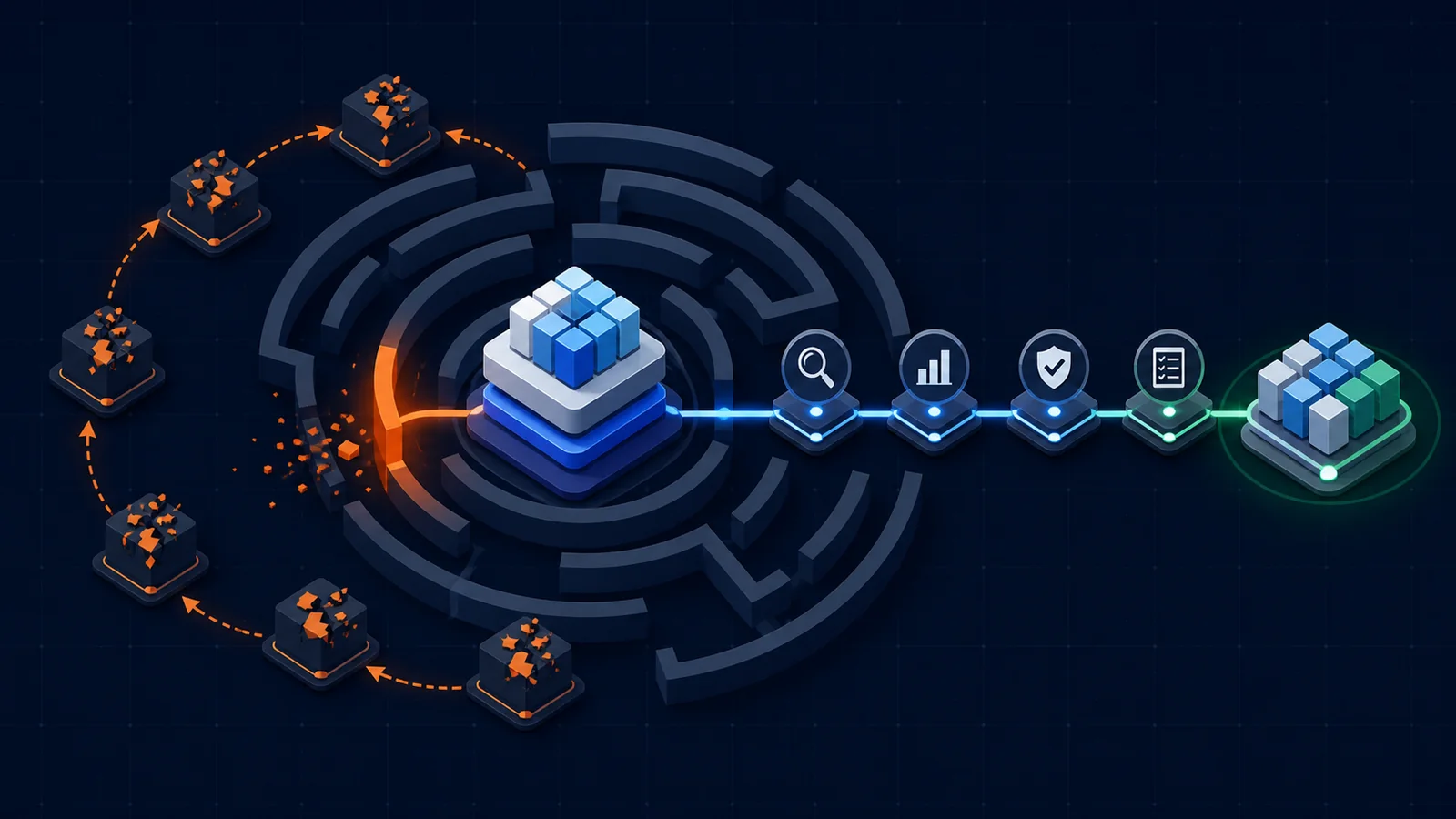
Vibe Coding Stuck? How to Recover Your AI-Built App
If your vibe-coded app is stuck in a loop, stop prompting blindly. Use this recovery guide to diagnose the failure layer, protect working progress, rebuild context, and choose the safest next move.
AI Agent Identity in 2026: Why Service Accounts Are Not Enough
AI agent identity and authorization must preserve who delegated authority, which agent is acting, what it may do, and where that authority ends. A shared service account cannot carry that context safely.
Browse all articles (16 more)Show fewer articles
AI Agent Observability: How to Monitor Agents in Production
AI agent observability connects traces, tool calls, policy decisions, costs, failures, and business outcomes so teams can understand and control production behaviour.
How to Modernize Legacy Software Without a Risky Full Rewrite
Modernize legacy software safely by mapping business risk, choosing a strategy per component, creating controlled seams, and replacing capabilities in measurable stages.
How to Automate Invoice Processing With AI (A Practical, No-Hype Guide)
A practical, step-by-step guide to automating invoice processing with AI -- how the pipeline actually works, what to watch out for, and how to roll it out without breaking your AP team's trust.
How to Write a Technical Requirements Document With AI Help (Without Losing Control of the Spec)
A practical framework for using AI to draft a technical requirements document -- the prompting sequence, the review checklist, and the mistakes that quietly wreck a spec.

Guardrails 101: Keeping AI Agents From Going Off-Script
AI agent guardrails work when deterministic controls limit authority, validate actions, cap impact, require approval, detect anomalies, and stop execution safely.

AI Agents vs RPA: Do You Still Need Both?
RPA is strongest on stable, repetitive steps. AI agents handle ambiguity and variable context. Most businesses need a governed combination rather than wholesale replacement.

Auditing AI Agent Actions: A Practical Starting Point
An AI agent audit trail should reconstruct intent, evidence, decisions, tool calls, approvals, results, cost, and versions—not merely store chat transcripts.

Multi-Agent Systems Explained (Without the Jargon)
Multi-agent orchestration coordinates specialised AI agents around one workflow. It helps when roles truly need separate context, tools, controls, or scaling.

What It Really Costs to Build a Business AI Agent
The model API is usually a minority of AI agent cost. Budget for workflow design, integration, data, evaluation, security, operations, and human review.

Closing the Pilot-to-Production Gap for AI Agents
AI agent pilots stall when teams optimise a prototype instead of proving a production operating model. Use outcome gates, real integrations, evaluations, and ownership.

AI Agent vs Chatbot: Key Differences and When to Use Each
An AI agent pursues an outcome through tools and multi-step decisions; a chatbot manages a conversation. Compare architecture, autonomy, risks, costs, and use cases.

Giving AI Agents Access to Company Data Without the Risk
Safe company-data access for AI agents starts with task-level permissions, data minimisation, identity-aware retrieval, output controls, and complete audit trails.

MCP Explained: What It Actually Does for Your AI Tools
Model Context Protocol gives AI applications a standard way to discover and use external tools, resources, and prompts. It is a connector—not an agent or security policy.

AI Agent Governance: What Small Teams Actually Need
Small-business AI governance does not need a committee maze. It needs clear ownership, a use-case register, authority limits, evidence, and an incident path.

Connecting AI Agents to Legacy Systems Without a Rebuild
You can connect AI agents to legacy systems safely through a controlled integration layer—without exposing databases or rewriting the core platform.

Why AI Agents Work in Demos but Fail in Production
AI agent demos optimise for the happy path. Production exposes ambiguity, permissions, changing systems, bad data, latency, cost, and accountability.
Decision tools
Move from reading to a clearer next step.
Modernization Readiness Score
Evaluate value, platform risk, dependency, and change readiness before sequencing the work.
Use the framework 02 / AutomateAutomation Value Matrix
Compare effort, error cost, variability, value, and automation risk before choosing a workflow.
Use the framework 03 / BuildBuild-or-Buy Decision Canvas
Test differentiation, fit, integration, total cost, control, and time before funding software.
Use the framework 04 / DeliveryConstraint-to-Capability Map
Connect a business constraint to system causes, responsible options, and measurable change.
Use the framework